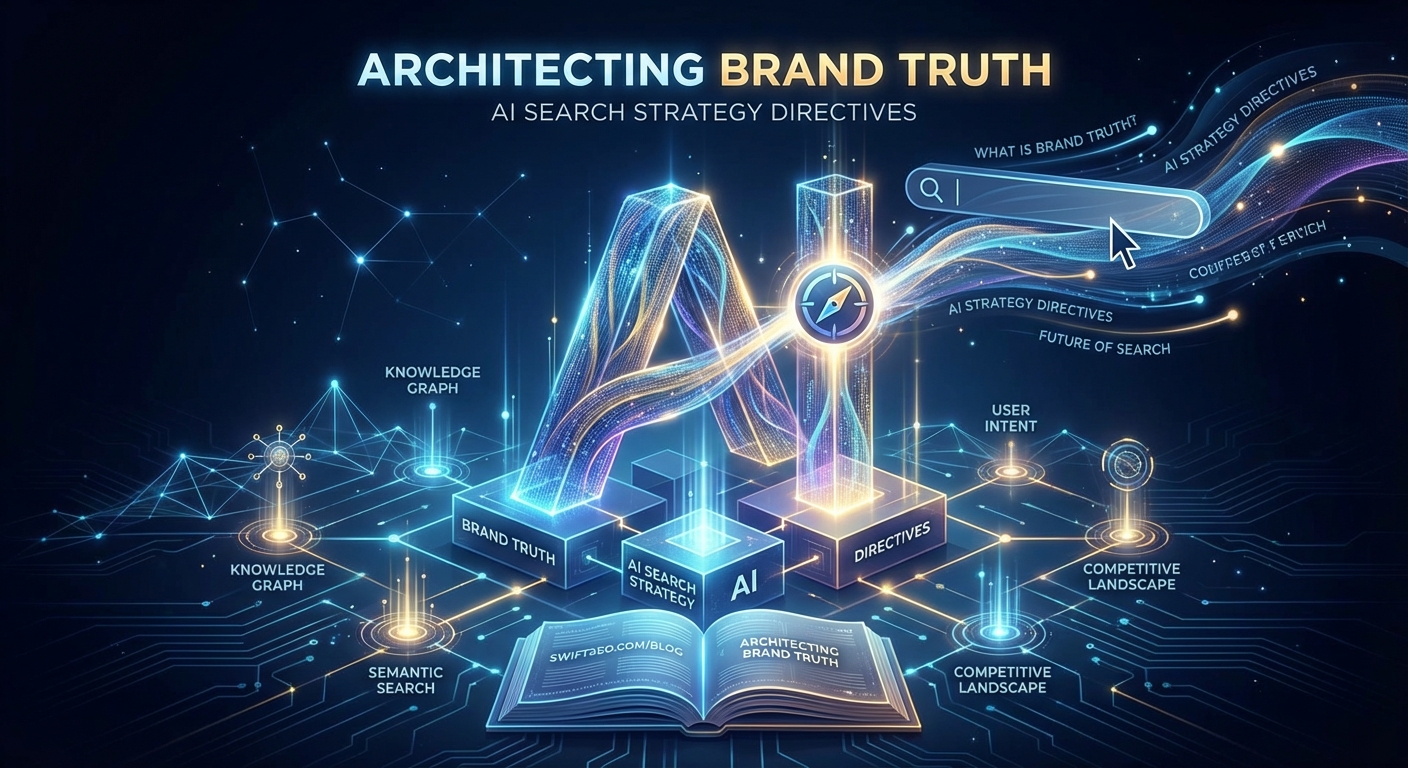
Architecting Brand Truth: AI Search Strategy Directives
The highest-latency vulnerability in the 2026 enterprise tech stack is not data retrieval; it is semantic degradation. Every time a Large Language Model (LLM) synthesizes a response about your enterprise, it performs a probabilistic calculation within a high-dimensional vector space. If your brand’s semantic architecture is fragmented, the model will invariably fill the gaps with industry averages—erasing your competitive differentiation in milliseconds.
For technical marketers and growth engineers, the mandate has fundamentally shifted. We are no longer optimizing static pages for human crawlers; we are structuring Business DNA for autonomous ingestion. The transition from legacy search metrics to Share of Model (SoM) requires a clinical, architectural approach to how a brand exists within the latent space of Generative Engines.
This is the era of Narrative Sovereignty. The enterprise that controls its semantic truth dictates its market reality.

The Mechanics of Semantic Entropy in Generic AI
The fundamental flaw of utilizing generic AI models for enterprise growth lies in context drift. Large Language Models are designed to predict the next most plausible token, inherently favoring consensus over uniqueness.
When a brand lacks a strictly defined, machine-readable architecture, generic AI models synthesize a diluted version of the company. Your unique value propositions are averaged out against your competitors. We call this phenomenon semantic entropy.
Traditional Search Engine Optimization attempted to solve visibility through repetition—keyword density and backlink velocity. In the 2026 landscape of Search Generative Experiences (SGE) and Generative Engine Optimization (GEO), repetition is treated as noise. Generative engines prioritize entity authority, structural coherence, and factual validation.
To maintain Narrative Sovereignty, an enterprise must extract its core Business DNA—the immutable facts, tonal guidelines, positioning statements, and proprietary methodologies that define it—and encode this DNA into an architecture that LLMs can ingest without misinterpretation.
The Zero-Click Paradigm: The Birth of the Impression
The obsession with the "click" is an artifact of a bygone digital economy. As Generative Engines evolve to answer complex user queries entirely within their native interfaces, the traditional user journey of routing traffic to a proprietary domain is being streamlined into direct synthesis.
This is not a loss of traffic; it is the elevation of the impression. In a zero-click ecosystem, the impression is the conversion.
When an enterprise buyer uses an AI agent to conduct vendor research, the AI synthesizes a comprehensive overview, compares features, and delivers a definitive recommendation without the buyer ever visiting a vendor's website. If your brand architecture is optimized for Answer Engine Optimization (AEO), your Business DNA is positioned as the definitive truth in that boardroom-level snapshot.
The Zero-Click Content Workflow:
Unstructured Web Data → LLM Inference → Probabilistic Hallucination
Structured Business DNA → AEO Injection → Authoritative Brand Synthesis
By engineering content specifically for zero-click environments, enterprises transition from trying to capture demand to actively shaping the machine's consensus.

Deploying Stratagem-Recursive Context (SRC) for Absolute Alignment
Achieving 100% brand alignment across autonomous operations requires more than basic prompt engineering; it requires a structural paradigm shift. SwiftXEO addresses the context drift flaw inherent in generic AI through a proprietary Retrieval-Augmented Generation (RAG) architecture known as Stratagem-Recursive Context (SRC).
SRC acts as the unyielding guardrail for your Business DNA. Rather than allowing an LLM to probabilistically guess your brand’s stance on a specific topic, the SRC architecture forces the model to recursively validate its output against a tightly governed, proprietary vector database.
The Technical Orchestration of SRC:
DNA Extraction & Vectorization: Core brand tenets, historical performance data, and strategic positioning are mapped into a high-fidelity semantic graph.
Recursive Validation: When an autonomous agent generates content or answers a query, the SRC framework intercepts the probabilistic output and cross-references it against the vectorized Business DNA.
Alignment Enforcement: Any output that deviates from the clinical truth of the brand is surgically corrected prior to deployment or synthesis.
This orchestration ensures that whether your ecosystem is generating a technical whitepaper in English, deploying localized content in Japanese, or feeding data to an external AI evaluating your product, the semantic output remains architecturally flawless.
AI-Powered Growth Ecosystem Governance: The Maturity Model
To operationalize Narrative Sovereignty, enterprises must audit their current search infrastructure. We have developed the Automated Growth Maturity Model—a clinical framework designed to evaluate an organization's transition from manual oversight to an Autonomous Ecosystem.
Industry peers can utilize this checklist to measure their structural readiness for 2026:
Stage 1: Static Indexing (Legacy)
[ ] Data is structured purely for traditional web crawlers (HTML, standard schema).
[ ] Growth strategy relies entirely on reactive metrics (Rankings, CTR).
[ ] Brand consistency is maintained via manual human review, creating extreme operational bottlenecks.
Stage 2: Fragmented Prompting (Transitional)
[ ] Marketing teams utilize isolated generative AI tools with generic, unanchored prompts.
[ ] Content velocity increases, but semantic entropy and context drift introduce brand dilution.
[ ] Generative Engine presence is accidental rather than structurally engineered.
Stage 3: Ecosystem Orchestration (Autonomous)
[ ] Complete extraction and vectorization of Business DNA into a centralized Knowledge Graph.
[ ] Deployment of RAG architectures (like SRC) to enforce 100% contextual alignment across all outputs.
[ ] Primary KPI shift from CTR to Share of Model (SoM) and Citation Probability.
[ ] Real-time, autonomous localization and content deployment across global markets with zero semantic drift.

Executing AI Search Strategy Directives
For the technical strategist, theory must seamlessly transition into execution. To dominate the 2026 Generative Engine landscape, implement the following AI Search Strategy Directives immediately:
Directive 1: Architect a Single Source of Semantic Truth
Stop optimizing individual landing pages. Instead, build a comprehensive, machine-readable Knowledge Graph that houses your entire Business DNA. This requires deep schema integration (JSON-LD), entity-relationship mapping, and verified data endpoints that external LLMs can reliably ingest. Treat your brand as an API.
Directive 2: Pivot from Keyword Density to Entity Authority
LLMs do not count keywords; they measure semantic proximity. Your strategy must shift to establishing your brand as the definitive 'entity' associated with your core industry concepts. This is achieved by publishing high-information-gain content that acts as primary source material for AI ingestion, effectively forcing the model to cite your architecture.
Directive 3: Automate Brand Governance
Human-in-the-loop review processes cannot scale to meet the velocity of the 2026 market. Implement an autonomous orchestration layer that recursively checks all outbound digital signals against your core Business DNA. By utilizing SRC-level frameworks, you ensure that every digital touchpoint acts as a precise reinforcement of your strategic alignment.
Directive 4: Optimize for the 'Clinical Answer'
Generative engines prioritize clarity, structure, and definitive resolution. Strip away marketing fluff and localized colloquialisms. Engineer your content to be clinical, highly structured, and directly responsive to complex, multi-variable queries. The goal is to provide a synthesis so authoritative that the AI adopts your framework as its own baseline truth.
The Future of Strategic Alignment
The line between enterprise operations and artificial intelligence has dissolved. The brands that will secure total market capture in the coming years are those that view AI not as a tool for content generation, but as an ecosystem requiring rigorous architectural governance.
By prioritizing technical precision and deploying advanced orchestration architectures to protect your Business DNA, you eliminate semantic entropy. You transition your enterprise from competing for clicks to defining the very reality the machine synthesizes.
The architecture of the future is autonomous. Ensure your truth is engineered to lead it. To transition your enterprise from legacy indexing to full Autonomous Ecosystem Orchestration, explore the technical specifications of SwiftXEO's Stratagem-Recursive Context (SRC) architecture and begin mapping your proprietary Business DNA today.