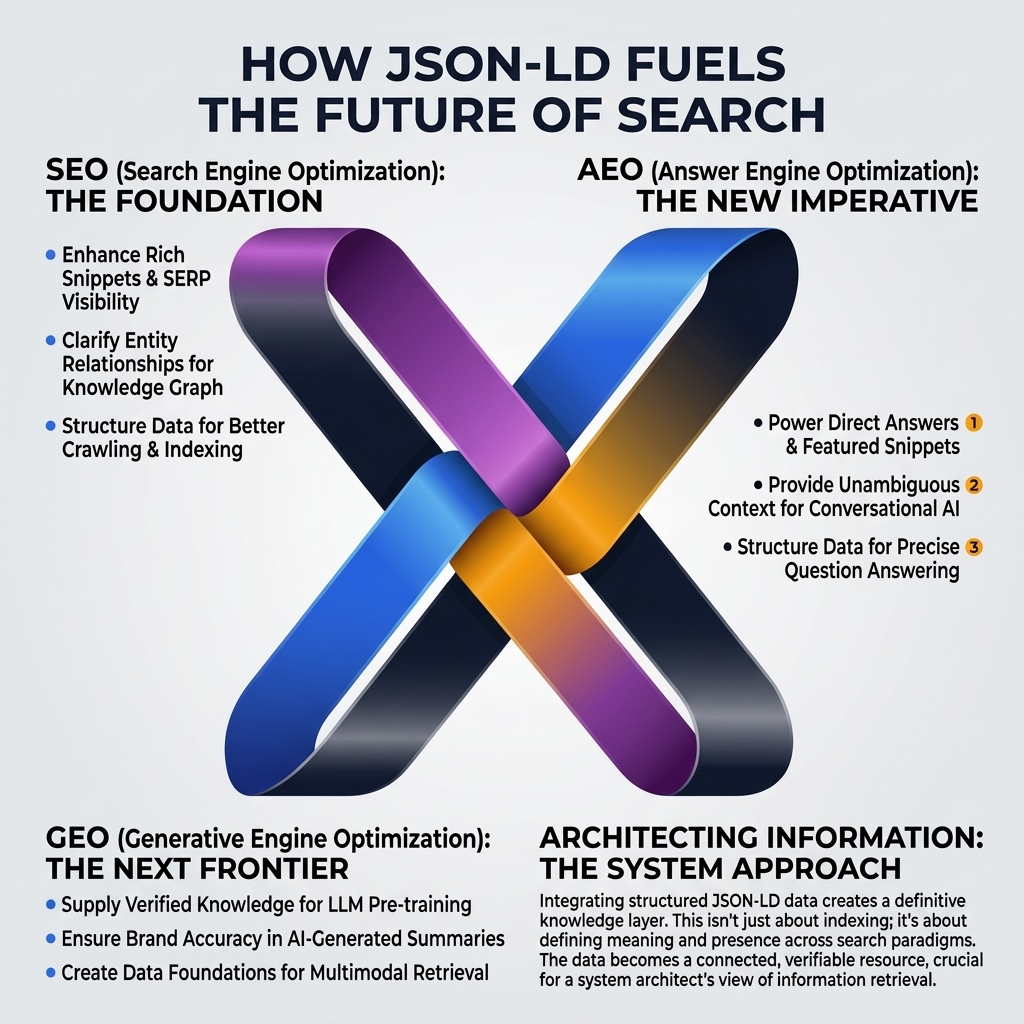
The Semantic API: Architecting JSON-LD for Generative Engine Optimization (GEO)
At 08:14 UTC this morning, an enterprise buyer queried a multi-agent system for a complex SaaS procurement solution. The winning vendor received zero clicks, zero website visits, and zero traditional search traffic. Instead, they secured a highly qualified pipeline opportunity purely because their underlying data architecture provided the highest semantic resonance for the machine's synthesis.
Welcome to the 2026 digital economy, where the traditional metric of the "click" has evolved into the "synthesized impression."
In this landscape, Large Language Models (LLMs) and Answer Engines do not read websites the way legacy crawlers did; they ingest structured data. For technical marketing leaders and growth engineers, JSON-LD and Schema markup are no longer just tools for achieving rich snippets on a search engine results page (SERP). They represent the critical neural APIs that bridge a brand's Business DNA to the global AI ecosystem.
This article explores the architectural imperative of structured data in 2026, detailing how strategic semantic orchestration establishes Narrative Sovereignty, prevents AI context drift, and maximizes your Share of Model in Generative Engine Optimization (GEO) and Answer Engine Optimization (AEO).
The Anatomy of the 2026 Synthesized Impression
The fundamental mechanism of digital discovery has inverted. We have transitioned from an era of human-driven retrieval to machine-driven synthesis. This shift necessitates a complete re-evaluation of how enterprise assets are structured.
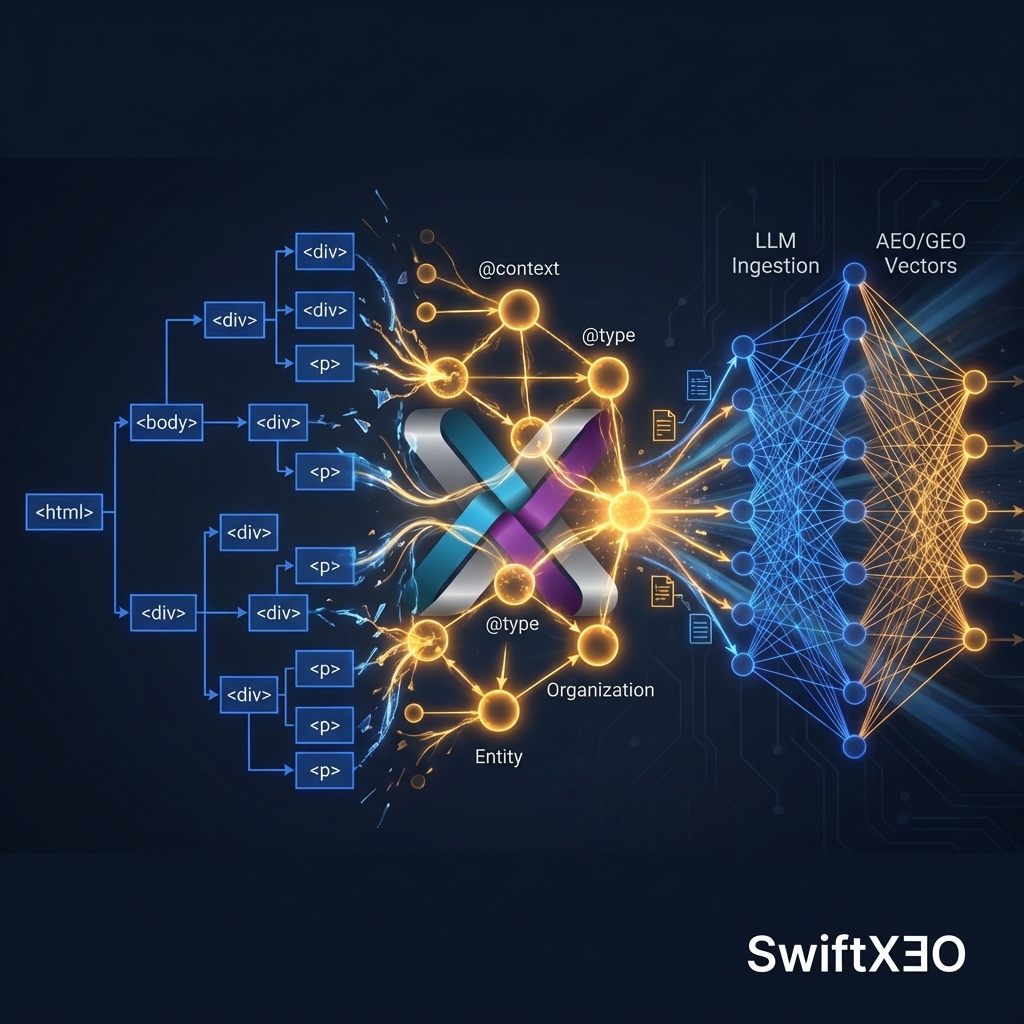
Generative Engine Optimization (GEO) requires moving beyond lexical keyword matching. When a generative model (like Gemini 2, Claude 4, or GPT-5) constructs an answer, it audits billions of parameters to calculate probability. If a brand's digital presence relies solely on unstructured HTML prose, it operates as a "black box" to these models. The AI must expend computational energy to infer meaning, increasing the likelihood of exclusion from the final output.
JSON-LD (JavaScript Object Notation for Linked Data) functions as a "glass box." It provides deterministic, machine-readable context. By explicitly defining entities, relationships, and attributes, you reduce the model's inference load, increasing the probability that your brand will be selected as the authoritative source.
In 2026, the strategic objective is capturing the Birth of the Impression—the exact moment an AI agent synthesizes a response for a user. To win this zero-click environment, your semantic architecture must be flawless.
Preventing Context Drift: The Role of Business DNA in Autonomous Ecosystems
A pervasive vulnerability in generic AI adoption is brand inconsistency, commonly referred to as "context drift." When autonomous agents operate without strict data guardrails, their outputs slowly deviate from the core brand narrative, resulting in fragmented signaling and strategic misalignment.
JSON-LD is the foundational layer for solving this. By thoroughly mapping your enterprise using comprehensive Schema.org vocabularies, you extract and digitize your core Business DNA.
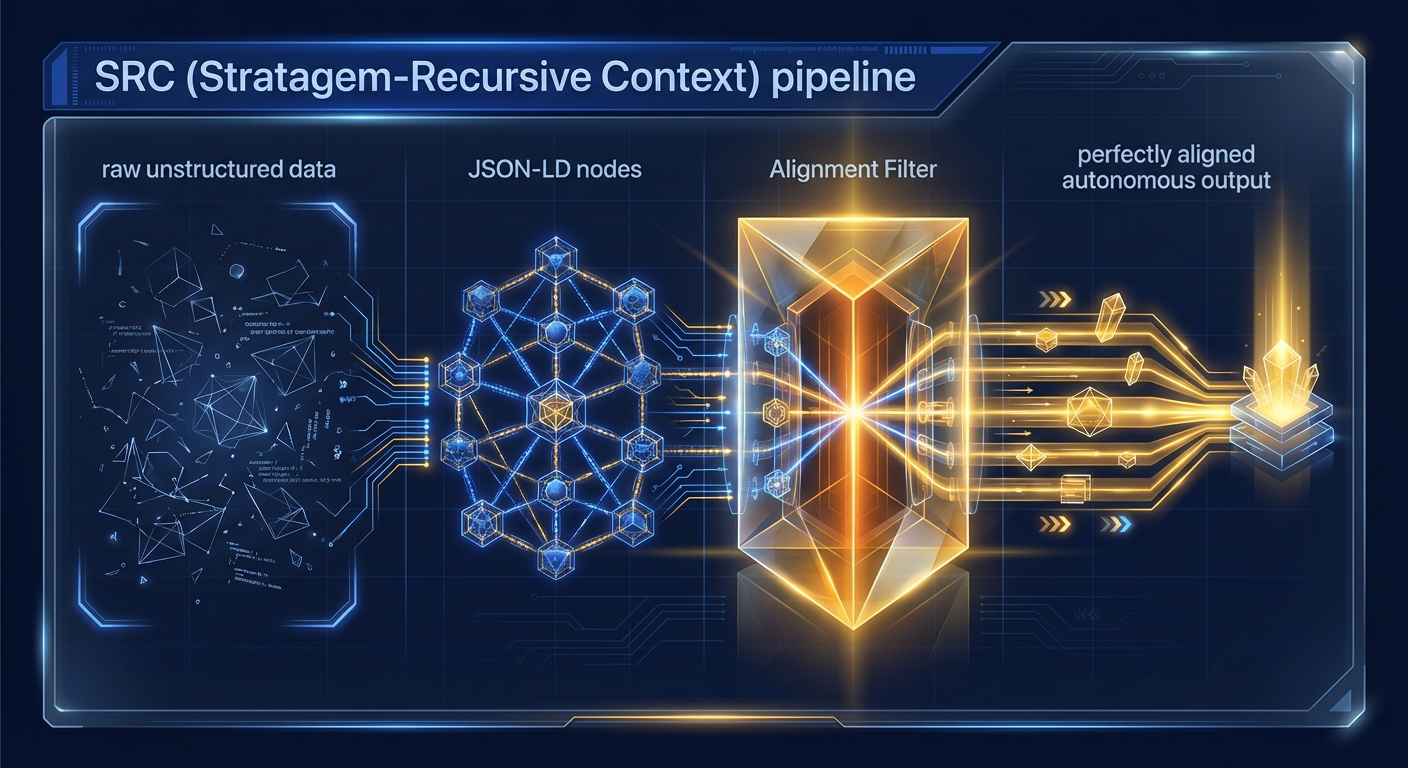
This is where SwiftXEO’s proprietary architecture provides a distinct technical advantage. SwiftXEO utilizes a specialized Retrieval-Augmented Generation (RAG) framework, augmented by Stratagem-Recursive Context). The workflow operates as follows:
Unstructured Brand Asset → JSON-LD Schema Structuring → SRC RAG Ingestion → Autonomous Execution
Through this pipeline, SwiftXEO reads your meticulously architected JSON-LD to enforce 100% brand alignment across all autonomous operations. When your data is structured natively as interconnected entities (e.g., nesting `Product` within `Organization`, linked to `FAQPage` and `Review`), the SRC architecture ensures that whether an external LLM is citing your brand, or an internal SwiftXEO agent is generating a localized campaign, the core narrative remains mathematically sovereign.
Architecting Answer Engine Optimization (AEO)
Answer Engine Optimization (AEO) is the specialized subset of GEO focused entirely on securing direct, cited answers within AI interfaces (like Perplexity or highly-augmented Search Generative Experiences).
To architect a website for AEO, technical teams must move beyond basic `LocalBusiness` or `Article` schemas and implement highly nested, relationship-driven JSON-LD.
1. Entity Disambiguation via `@id` and `sameAs`
Answer Engines synthesize authority by cross-referencing global knowledge graphs. Utilizing the `sameAs` property to link your corporate entities to verified Wikidata, Bloomberg, or Crunchbase profiles is non-negotiable. Furthermore, using `@id` node identifiers allows you to create recursive relationships within your own page.
Instead of declaring the publisher as a string of text, you define the publisher as an `@id` node that references your globally defined `Organization` schema. This creates a closed-loop of semantic trust that Answer Engines prioritize.
2. The Dominance of QA and FAQ Schemas
Answer Engines are explicitly trained on question-and-answer pairs. Deploying `FAQPage` schema is the most direct method of injecting your Business DNA into an LLM's training and retrieval pipeline. However, in 2026, these pairs must be structured to address high-intent, long-tail agentic queries (e.g., "What are the compliance parameters for [Product] in the EU market?") rather than simple navigational questions.
3. Real-Time Schema Injection
Static data decays. Operational excellence in 2026 is measured by the interval between a market shift and your data's ingestion by the global neural network. Utilizing a platform like SwiftXEO enables autonomous, real-time schema injection. When a product specification changes, the JSON-LD updates instantly across the global ecosystem, ensuring zero strategic latency.
AI-Powered Growth Ecosystem Governance
As enterprises scale, managing this semantic layer manually becomes impossible. The shift toward an Autonomous Ecosystem requires rigorous governance to ensure that the AI agents representing your brand are operating from the most accurate, highly-structured data available.
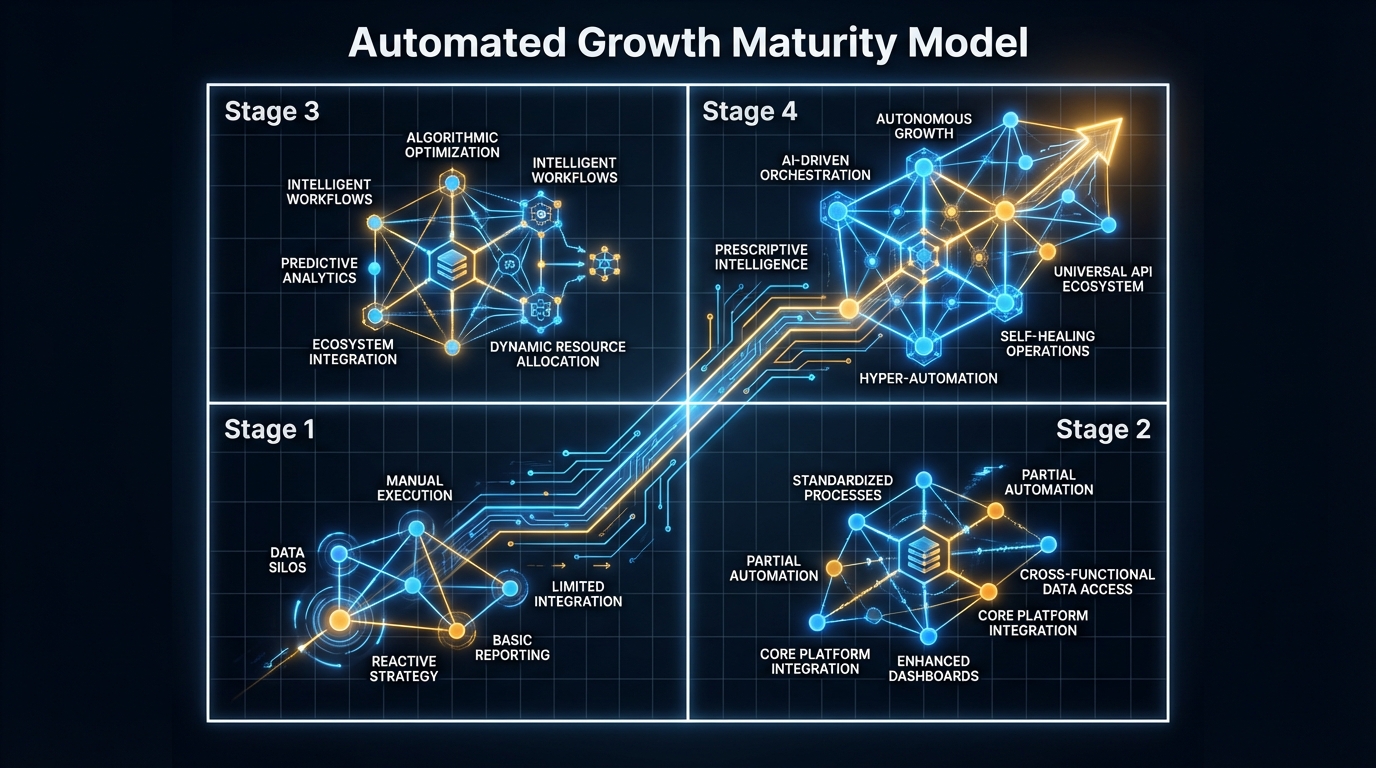
To facilitate this transition, SwiftXEO has engineered the Automated Growth Maturity Model. This framework allows technical marketing leaders to benchmark their semantic architecture against the demands of the 2026 synthetic economy.
The Automated Growth Maturity Model (Overview)
Stage 1: Lexical Baseline (Legacy): Relies on unstructured HTML, basic keyword mapping, and manual schema tagging. Highly susceptible to context drift and low Share of Model.
Stage 2: Semantic Structuring (Transitional): Implementation of dynamic JSON-LD, entity disambiguation, and structured AEO content. Establishes a foundational glass box for LLM ingestion.
Stage 3: Agentic Orchestration (Advanced): Continuous, real-time schema deployment. Integration with advanced RAG architectures. Complete narrative sovereignty established across all global data nodes.
Stage 4: Autonomous Ecosystem (The SwiftXEO Standard): AI-powered governance where market signals autonomously trigger updates to the underlying Business DNA, automatically refining the semantic architecture for predictive GEO dominance.
Actionable Engineering Directives for 2026
To establish architectural dominance and maximize your Share of Model, technical marketing peers must immediately initiate the following directives:
Audit Your Semantic Density: Run a comprehensive crawl of your digital properties specifically targeting the depth of your JSON-LD. Are your entities isolated, or are they connected via `@id` references?
Deploy Stratagem-Recursive Context (SRC): Transition away from generic generative AI wrappers. Ensure that your internal content generation and external data structuring are unified under an SRC architecture that enforces brand truth.
Optimize for the Synthesized Impression: Stop measuring success purely by traditional traffic. Implement tracking for 'Citation Probability' and 'Share of Model' across primary LLMs by monitoring how often your highly-structured nodes are referenced in generative outputs.
Automate Ecosystem Governance: Replace manual schema management with autonomous deployment systems. The speed at which you can structure and serve data to an Answer Engine directly correlates to your market share in a zero-click environment.
Conclusion: Orchestrating the Future of Growth
The evolution from human-intermediated search to AI-driven synthesis is complete. In 2026, your website is no longer merely a destination for human readers; it is a highly structured database designed for machine ingestion.
JSON-LD and Schema are the architectural frameworks that make this ingestion possible. By transforming your digital presence into a mathematically precise reflection of your Business DNA, you eliminate context drift, establish Narrative Sovereignty, and ensure that when the machines synthesize the future of your industry, your enterprise is positioned as the undisputed authority.
Ready to architect your transition?
Ensure your enterprise is prepared for the synthetic economy. Download the comprehensive Automated Growth Maturity Model Checklist to audit your semantic infrastructure today, and discover how SwiftXEO's autonomous ecosystem can engineer your total market dominance.