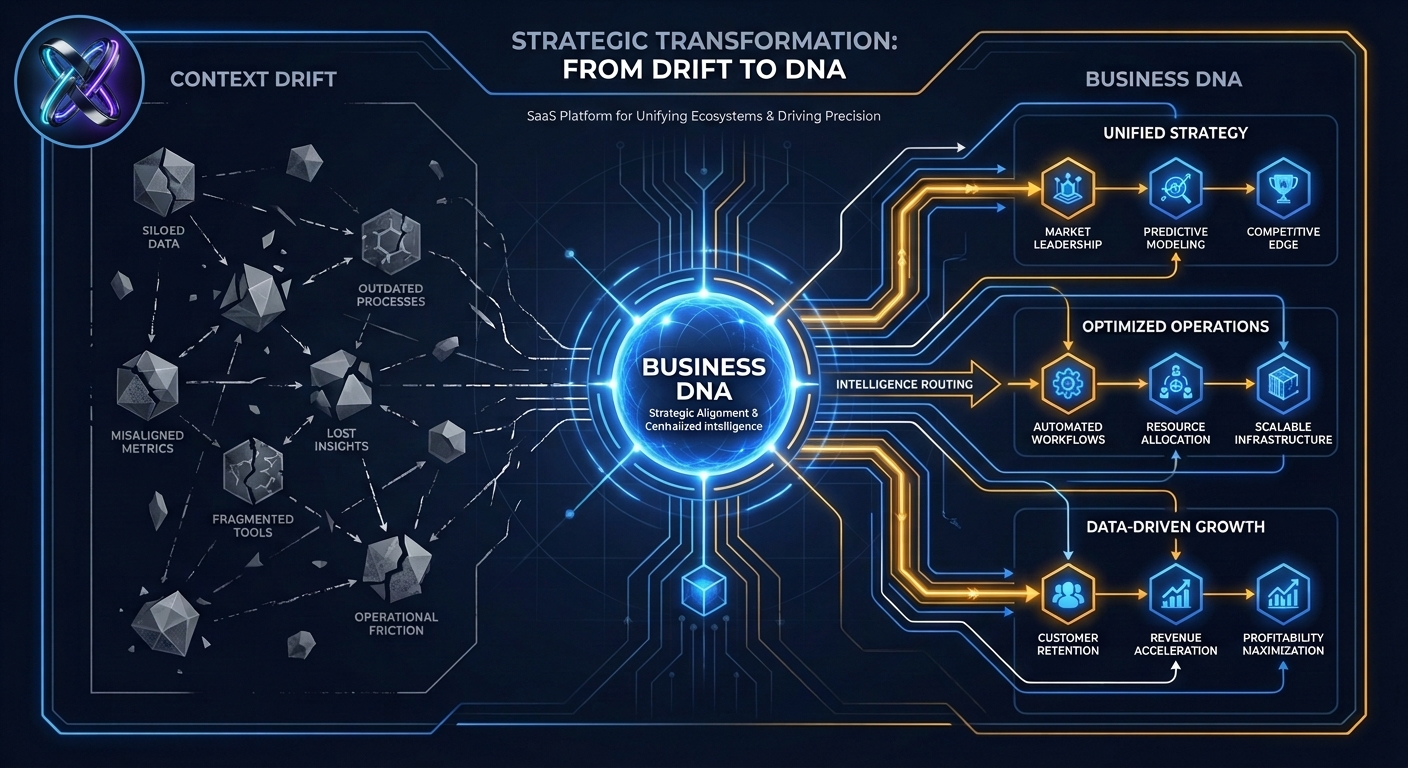
Stop Context Drift: AI Search Gap Analysis for Enterprise Leaders
EXECUTIVE SUMMARY
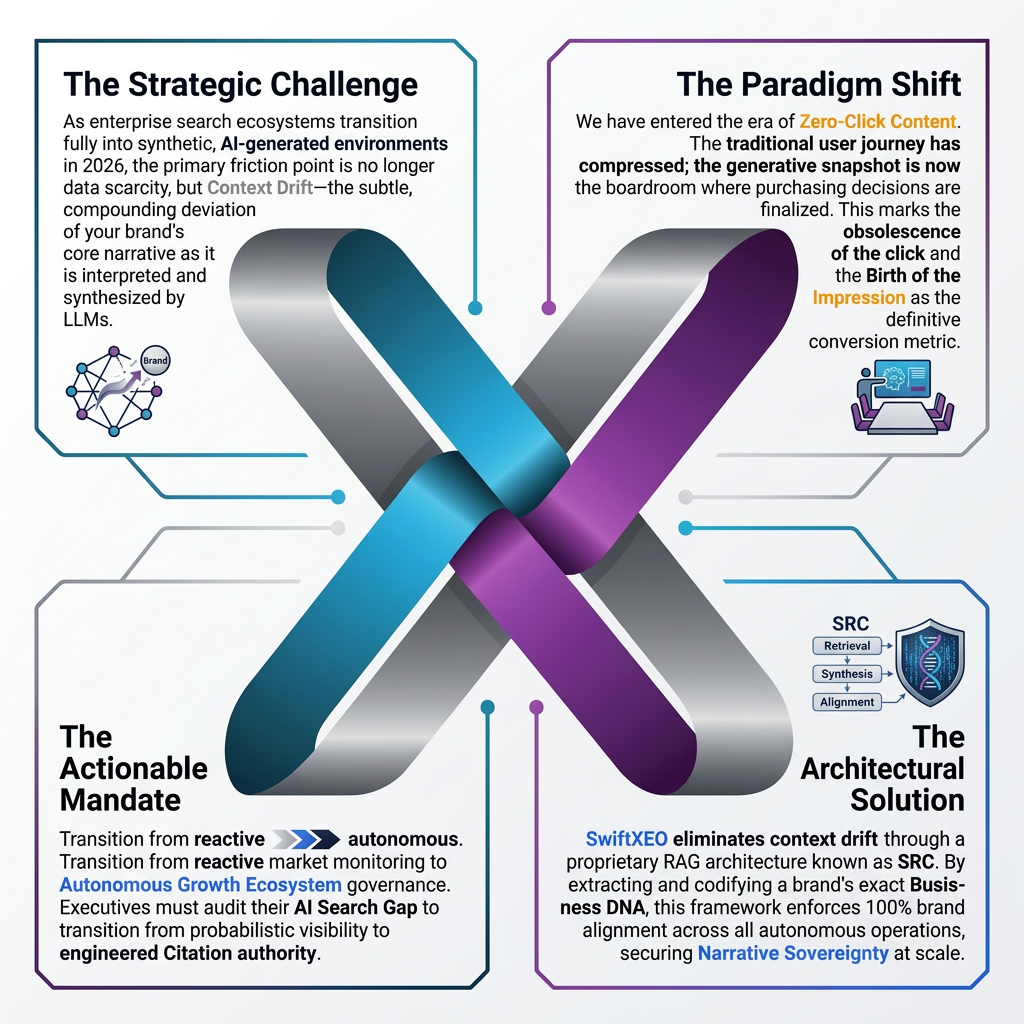
The Strategic Challenge: As enterprise search ecosystems transition fully into synthetic, AI-generated environments in 2026, the primary friction point is no longer data scarcity, but Context Drift—the subtle, compounding deviation of your brand’s core narrative as it is interpreted and synthesized by Large Language Models (LLMs).
The Paradigm Shift: We have entered the era of Zero-Click Content. The traditional user journey has compressed; the generative snapshot is now the boardroom where purchasing decisions are finalized. This marks the obsolescence of the click and the Birth of the Impression as the definitive conversion metric.
The Architectural Solution: SwiftXEO eliminates context drift through a proprietary RAG (Retrieval-Augmented Generation) architecture known as SRC. By extracting and codifying a brand's exact Business DNA, this framework enforces 100% brand alignment across all autonomous operations, securing Narrative Sovereignty at scale.
The Actionable Mandate: Transition from reactive market monitoring to Autonomous Growth Ecosystem governance. Executives must audit their AI Search Gap to transition from probabilistic visibility to engineered citation authority.
In 2026, the greatest inefficiency in global market expansion is not a lack of artificial intelligence—it is the erosion of brand truth.
When enterprise data is distributed across disparate digital touchpoints without a unified governance layer, LLMs (like GPT-5, Claude 4, and Gemini) are forced to rely on probabilistic guessing to understand your market position. This process introduces Context Drift: a steady, mathematical dilution of your strategic messaging. By the time an AI agent synthesizes an answer for a high-value buyer, your brand’s unique value proposition has been averaged out into industry noise.
To maintain market leadership, the C-Suite must evolve past traditional SEO metrics and conduct a clinical AI Search Gap Analysis. The objective is to identify where narrative leakage occurs and architect an ecosystem that guarantees absolute Strategic Alignment within the machine's synthesis.
The Mechanics of Context Drift in a Synthetic Landscape
In legacy search environments, brands controlled the narrative by directing users to a meticulously crafted landing page. The architecture of 2026 operates differently. Large Language Models do not index pages; they ingest, synthesize, and reformulate concepts.
If your technical precision and structural integrity are lacking, the LLM will confidently hallucinate a version of your brand that aligns with generalized industry assumptions rather than your specific capabilities. This gap between your intended corporate strategy and the AI’s generated output is the AI Search Gap.
The Birth of the Impression
This gap becomes critically important when examining the momentum behind Zero-Click Content for SGE (Search Generative Experience) and GEO (Generative Engine Optimization). We are witnessing the Birth of the Impression as the final stage of the buyer journey.
When a synthetic intelligence provides a comprehensive, synthesized answer directly in the search interface, the traditional click-through rate (CTR) becomes a secondary metric. If your brand’s true Business DNA is not accurately reflected in that initial AI-generated impression, the buyer journey ends before it begins. The impression itself is the new conversion event.
Conducting an AI Search Gap Analysis
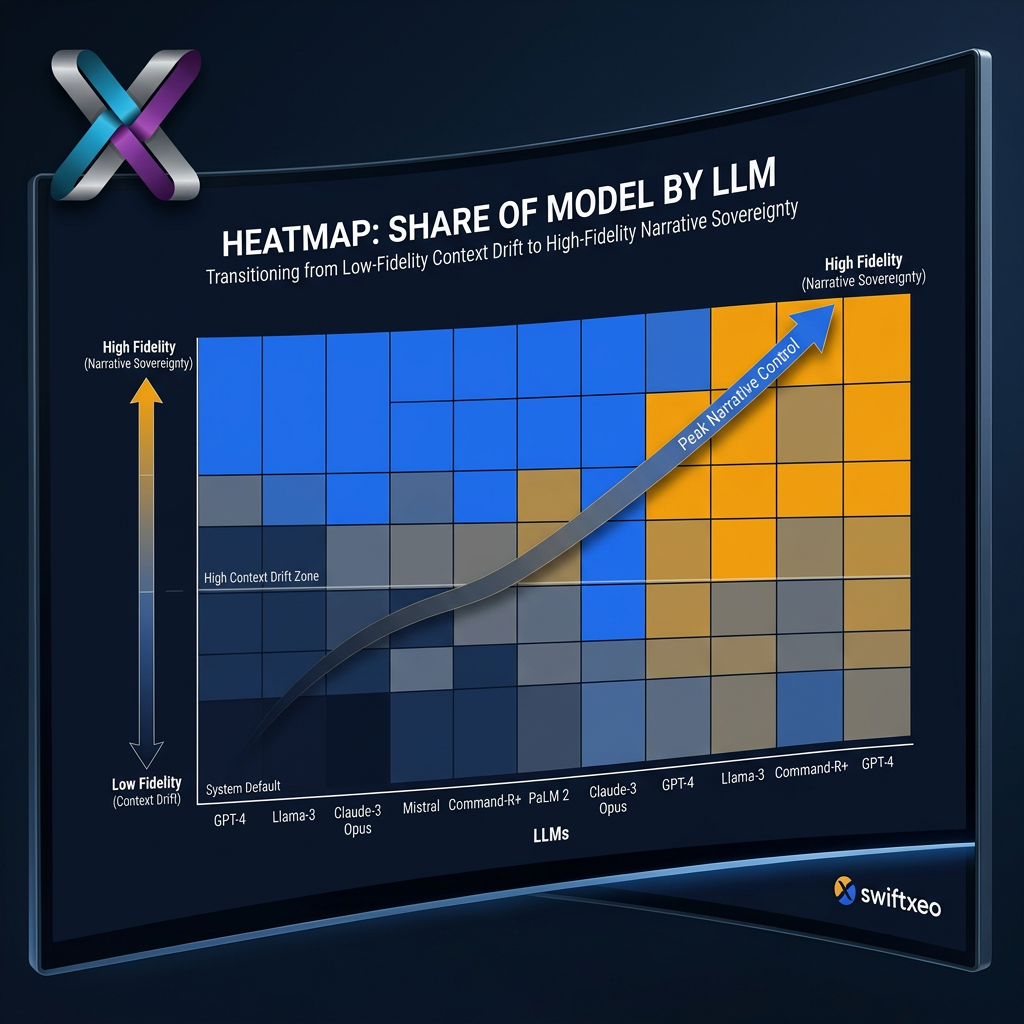
To correct Context Drift, enterprise leaders must first quantify it. An AI Search Gap Analysis is a diagnostic framework designed to measure the delta between your authoritative truth and your current Share of Model (SoM)—the frequency and accuracy with which your brand is cited in relevant AI outputs.
A board-ready analysis evaluates three critical dimensions:
Citation Probability: What is the statistical likelihood that an AI agent will reference your brand when prompted with a category-specific query?
Narrative Fidelity: When cited, does the LLM accurately reflect your most current capabilities, pricing models, and strategic differentiators, or is it relying on outdated, scraped data?
Ecosystem Coherence: Are your global, multilingual digital assets projecting a unified truth, or are regional silos providing contradictory signals that confuse the AI's confidence scoring?
Architecting the Remedy: Business DNA and SRC Integration
Generic AI tools attempt to solve visibility issues through brute-force content generation. This merely scales the chaos, compounding Context Drift by flooding the ecosystem with syntactically correct but strategically hollow information.
True Narrative Sovereignty requires an architectural approach. SwiftXEO’s unique methodology centers on the extraction and deployment of your Business DNA—the immutable, foundational truths of your enterprise.
This is executed through our proprietary RAG (Retrieval-Augmented Generation) architecture, known as the SRC framework. The workflow is surgically precise:
Raw Enterprise Data → Business DNA Extraction → SRC RAG Ingestion → Autonomous Orchestration
By routing all content generation, schema deployment, and market intelligence through the SRC architecture, SwiftXEO ensures that every autonomous output is strictly governed by your Business DNA. This mechanism guarantees 100% brand alignment across all channels, languages, and formats. The AI does not guess; it retrieves the engineered truth.
Orchestrating an Autonomous Growth Ecosystem
Achieving alignment is only the first step; maintaining it at a global scale requires Autonomous Efficiency.
The modern enterprise cannot rely on manual human intervention to continuously update knowledge graphs, deploy schema markups, and localize content for 30 different regions. The latency inherent in human-intermediated growth creates a window for Context Drift to return.
SwiftXEO transforms digital presence from a static list of directories into a dynamic, Autonomous Growth Ecosystem. By automating the deployment of structurally perfect data directly into the latent space of LLMs, we provide the ultimate AI-Powered Growth Ecosystem Governance. This ensures that as your corporate strategy pivots, your global synthetic footprint updates with zero latency.
Strategic Directives for the Boardroom
To secure long-term market dominance in 2026, the C-Suite must adopt the following architectural directives:
Elevate AEO to a Board-Level Priority: Answer Engine Optimization (AEO) is no longer a tactical marketing function. It is a core pillar of enterprise risk management and brand equity protection.
Audit for Signal Dilution: Mandate a comprehensive AI Search Gap Analysis to uncover where legacy data structures are currently diluting your strategic narrative within major LLMs.
Implement DNA-Governed Architecture: Retire generic, unaligned AI content generation tools. Standardize your growth operations on a platform that uses proprietary RAG architecture to enforce brand truth.
Measure Share of Model (SoM): Transition executive dashboards away from traffic metrics and focus strictly on Citation Probability, Narrative Fidelity, and overall Share of Model.
The Next Step in Autonomous Governance
Understanding the gap is the prerequisite to closing it. The transition from legacy search management to autonomous ecosystem orchestration requires a clinical, phased approach.
To benchmark your current operational readiness and secure your Business DNA against Context Drift, download our Automated Growth Maturity Model checklist. This executive tool is designed to position your enterprise as the authoritative source from which tomorrow’s AI agents derive their truth.